
Archive for October 2025
What is an Ultrawide Field Camera?

As retinal imaging advances, ultrawide field (UWF) cameras have opened new horizons for eye care.We’ve moved beyond the 10°–30° views of early fundus cameras to systems that reach the far periphery, capturing about 200° in a single image (~82% of the retina). This expanded perspective improves detection and risk stratification of peripheral disease (e.g., identifying…
Read MoreWhat is a Perimeter?

A perimeter is the instrument used for visual field testing; perimetry is the test itself that maps how you see across central and peripheral vision. Your vision extends beyond what you see straight ahead. Measuring the peripheral field is essential for detecting and monitoring glaucoma and for localizing neurologic pathway lesions (e.g., stroke, pituitary disease). …
Read MoreWhat is a Pachymeter?

Precision matters in eye care, especially when corneal thickness can influence pressure readings and surgical decisions. Pachymetry measures corneal thickness in micrometers (µm). It helps interpret applanation IOP readings, informs glaucoma risk, supports refractive surgery planning, and assists in evaluating corneal disease over time. If you’ve ever wondered what exactly a pachymeter is, it’s the…
Read MoreWhat is an OCT?
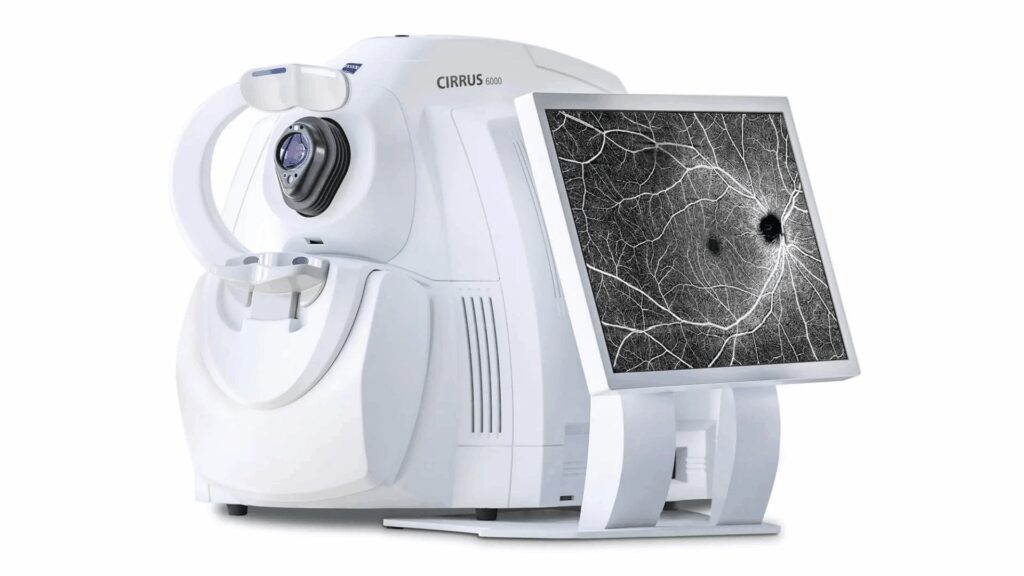
What is optical coherence tomography (OCT)? For a clear, layer-by-layer view of retinal structure, clinicians use imaging beyond standard fundus photos. Optical coherence tomography (OCT) is a noninvasive imaging technique based on low-coherence interferometry that produces high-resolution cross-sections of the eye. By mapping retinal layers and the optic nerve/nerve fiber layer, OCT helps clinicians diagnose…
Read More